close
Choose Your Site
Global
Social Media

Views: 0 Author: Site Editor Publish Time: 2026-09-02 Origin: Site


In commercial and industrial cooling, the refrigeration compressor dictates up to 80% of the system’s total energy consumption. Selecting the wrong unit compromises load management and rapidly inflates your operating costs. As the true heart of the refrigeration cycle, this mechanical component carries immense operational weight. Its mechanical properties directly influence temperature stability, routine maintenance intervals, and strict regulatory compliance.
Facility managers and HVAC engineers evaluating new or replacement equipment face a complex challenge. You must understand exact compressor properties to balance initial capital expenditure against long-term reliability and daily operating expenses. Thorough evaluation prevents disastrous system failures. We will explore the five main compressor types and their critical thermodynamic properties. You will also learn how to navigate compliance standards and use a simple framework for shortlisting the best equipment for your facility.
The ideal refrigeration compressor depends heavily on your system's required cooling capacity, operating temperatures, and load variability.
Key evaluation properties include volumetric efficiency, compression ratio limits, and compatibility with low-GWP (Global Warming Potential) refrigerants.
Total Cost of Ownership (TCO)—factoring in energy efficiency standards (e.g., UK ETL, EPA compliance) and routine maintenance—must drive the final procurement decision over baseline equipment costs.
Distinct mechanical designs (Scroll, Screw, Reciprocating, Centrifugal) offer rigid, verifiable trade-offs between continuous heavy-duty operation and modular scalability.
Compressor inefficiency inevitably leads to systemic failure. When a compressor struggles to meet demand, cold storage facilities suffer massive product loss. Utility bills also skyrocket due to constant, inefficient cycling. These business problems stem directly from poorly matched mechanical properties. Facility managers must prioritize thermodynamic fit over basic brand preference.
You can better understand this by looking at the cycle context. The compressor sits perfectly between the evaporator and the condenser. It pulls low-pressure, low-temperature refrigerant vapor from the evaporator. It then mechanically squeezes this vapor. Finally, it pushes high-pressure, high-temperature vapor into the condenser. This specific pressure transition drives the entire cooling process.
A successful deployment requires strict alignment. You must match the compressor’s displacement and thermodynamic limits to the facility's actual cooling loads. You should account for both peak and partial loads. Avoid oversizing the equipment at all costs. Oversizing leads to short-cycling. Short-cycling degrades mechanical parts and ruins energy efficiency. Selecting a perfectly sized Refrigeration Compressor guarantees stable economics.
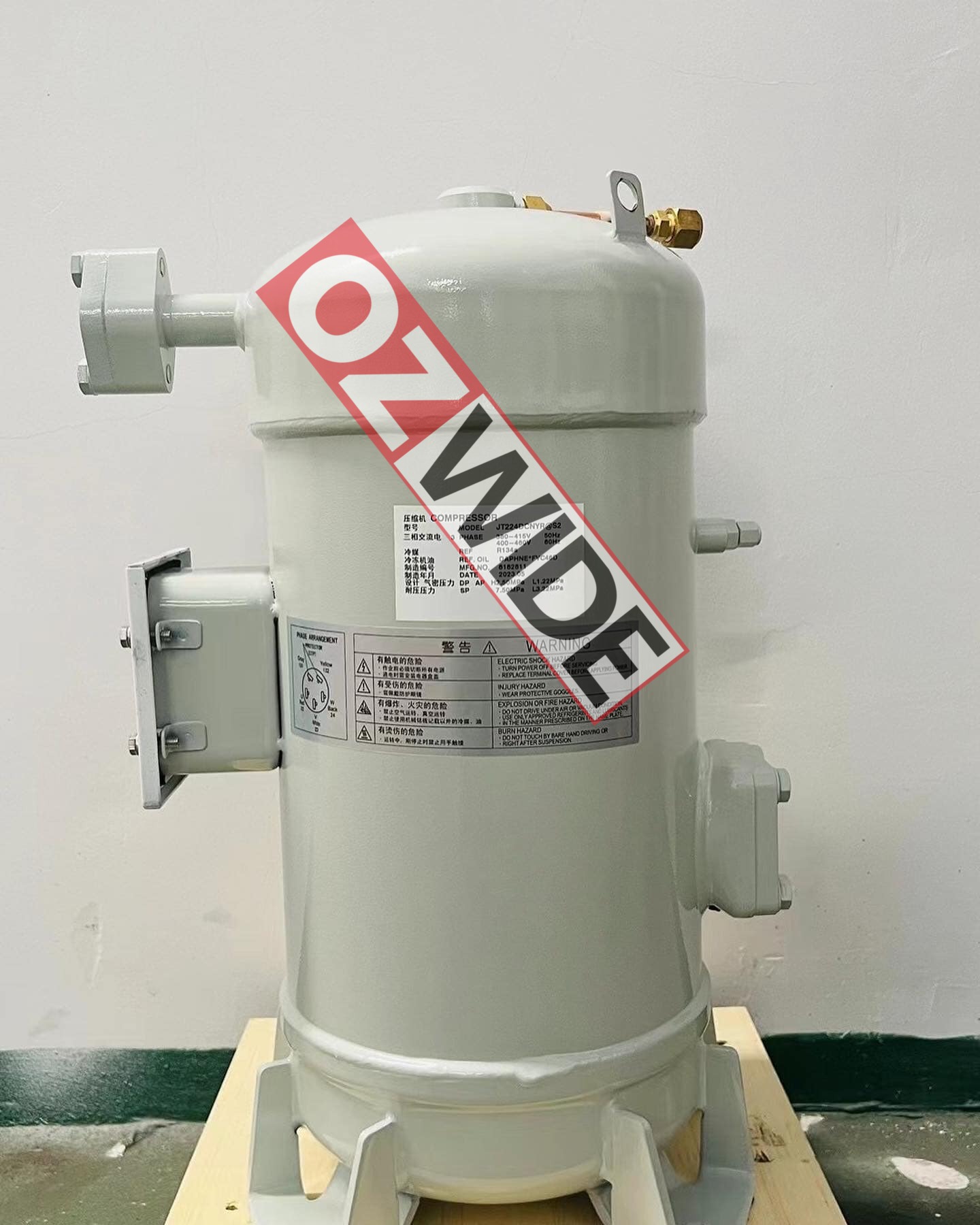
Reciprocating compressors use piston-driven mechanisms inside cylinders. They are highly versatile machines. These units easily achieve high pressure ratios. Manufacturers build them in open, semi-hermetic, and hermetic configurations. They provide reliable cooling across varying ambient conditions.
Best For: Broad commercial applications, modern supermarkets, and systems requiring fluctuating load management.
Risks: They produce higher vibration levels. They contain more moving parts. This complexity leads to stricter and more frequent maintenance schedules.
Scroll compressors utilize two distinct spiral metal pieces. One scroll remains stationary while the other orbits inside it. This orbital motion creates continuous compression. They contain very few moving parts. They achieve exceptional volumetric efficiency at specific pressure ratios.
Best For: Medium-scale commercial HVAC systems, walk-in coolers, and commercial rooftop units.
Risks: They feature a hermetic seal. You generally cannot service their internal mechanics. Mechanical failure requires a complete unit replacement.
Screw compressors operate using twin interlocking rotors. As the rotors turn, they compress the refrigerant vapor trapped between them. They offer exceptional durability for industrial settings. They also provide step-less capacity control via internal slide valves. This allows precise load matching.
Best For: Heavy industrial refrigeration, large-scale cold storage facilities, and continuous heavy-duty cooling cycles.
Risks: They require complex oil management systems. They also demand dedicated cooling mechanisms to prevent rotor expansion.
Rotary compressors use rotating vane or roller mechanisms inside a cylinder. They offer a highly compact footprint. These units run very quietly. Their simple design reduces internal friction significantly. They are cost-effective to manufacture and install.
Best For: Small commercial display cases, reach-in freezers, and localized low-capacity cooling units.
Risks: They lack the required scalability for large commercial spaces. They struggle under massive cooling demands.
Centrifugal compressors rely on kinetic energy compression. An impeller spins rapidly to accelerate the refrigerant vapor. A diffuser then converts this velocity into static pressure. They handle massive high-volume refrigerant flows effortlessly. Some modern models feature magnetic bearings for completely oil-free operation.
Best For: Massive district cooling networks and large industrial chillers typically exceeding 200 tons.
Risks: They perform poorly under low-load conditions. This creates a severe surge risk. They also require very high initial capital expenditure.
Table: Core Compressor Properties Comparison
Property Category | Key Metric | Operational Impact |
|---|---|---|
Efficiency | Volumetric / Isentropic | Determines power consumption relative to cooling output. |
Capacity | Swept Volume / Displacement | Dictates maximum heat rejection capability. |
Compatibility | GWP Limits / Pressures | Ensures safety and regulatory compliance. |
Lubrication | Oil Return Rate | Prevents mechanical seizing and piping blockages. |
Volumetric efficiency defines how effectively the compressor moves vapor compared to its theoretical maximum volume. Isentropic efficiency measures the actual work input against an ideal, frictionless compression process. High efficiency ratings mean lower daily energy consumption. You must monitor these metrics closely.
Efficiency drops sharply as the compression ratio increases. The compression ratio compares condensing pressure against evaporating pressure. Extreme temperature differences force the compressor to work harder. This dynamic reduces volumetric efficiency. You will pay higher utility costs if you ignore this relationship.
Swept volume directly dictates the total amount of heat the system can reject. It represents the physical space cleared by the piston or rotor per revolution. Higher displacement equals higher maximum cooling capacity. However, raw displacement only matters at peak demand times.
Variable frequency drives (VFDs) interact dynamically with displacement. A VFD adjusts the motor speed to match partial-load conditions. This integration dramatically improves partial-load efficiency. It prevents the system from running at full capacity when demand drops. Proper VFD pairing protects your equipment investment.
The industry is shifting rapidly toward natural refrigerants. CO2, Ammonia, and Propane are replacing older synthetic gases. A2L blends are also gaining massive traction. Your chosen Refrigeration Compressor must handle these specific chemical properties safely.
High operating pressures require specialized mechanical designs. Transcritical CO2 systems, for example, operate at extreme pressures. Standard compressors will rupture under these conditions. You need heavily reinforced compressor properties to contain CO2 safely. Always verify material compatibility before finalizing your purchase.
Compressor lubrication prevents catastrophic metal-on-metal friction. Splash lubrication works well for small, low-speed units. The moving parts simply dip into an oil sump. Forced-feed systems use a dedicated oil pump. They deliver pressurized oil directly to critical bearings. Large commercial units absolutely require forced-feed systems.
Oil migration poses a massive operational risk. Extensive commercial piping networks can trap lubricating oil. The oil leaves the compressor but fails to return. This starves the bearings and ruins heat transfer in the evaporator. You must design proper piping traps to ensure consistent oil return.
Vibration and Acoustic Profiles: Heavy industrial compressors generate intense physical vibrations and noise. You must evaluate the structural requirements for dampening these forces. Commercial mechanical rooms often require isolated concrete pads. Spring isolators help minimize structural vibrations. You must also review local noise ordinances. Meeting OSHA acoustic limits protects your workers and prevents costly fines. Enclosures and acoustic blankets offer practical mitigation strategies.
Wear and Tear Predictability: Different designs have distinct overhaul intervals. Screw compressors require expensive bearing replacements after 40,000 to 50,000 hours. You can plan these overhauls predictably. Reciprocating compressors experience wear on valve plates and piston rings much earlier. However, these parts are cheaper and easier to replace. You must weigh predictable major overhauls against frequent minor repairs. Always stock critical wear parts to minimize operational downtime.
Thermal Overload Management: Compressors generate enormous internal heat during the compression cycle. Enclosed commercial mechanical rooms trap this heat rapidly. You must address motor cooling necessities. Refrigerant-cooled motors rely on suction gas to absorb internal heat. Air-cooled motors need robust external ventilation. If mechanical room temperatures spike, the compressor motor will trip on thermal overload. Proper ventilation design prevents random system shutdowns during peak summer months.
Regulatory frameworks dictate modern procurement strategies. You must cross-reference all compressor specifications with local energy technology lists. The UK Energy Technology List (ETL) and US Department of Energy (DOE) standards define strict baseline efficiencies. Non-compliant equipment faces hefty penalties. Installing verified equipment often unlocks lucrative government rebates or tax incentives. Compliance is no longer optional for commercial builds.
Eco-Design directives enforce Minimum Energy Performance Standards (MEPS). These directives systematically rule out older, inefficient compressor models. You cannot install legacy technology in new commercial builds. MEPS forces the adoption of high-efficiency scroll and screw designs. Familiarize yourself with the latest regional MEPS criteria. They update frequently to push the industry toward zero-carbon goals.
Phase-down readiness ensures long-term asset viability. Global regulations are aggressively phasing down high-GWP refrigerants. Ensure the selected equipment is rated for drop-in replacement refrigerants. If your compressor cannot handle next-generation gases, it becomes a stranded asset. A stranded asset requires premature replacement. Future-proofing your equipment prevents massive capital losses when regulations inevitably tighten.
Following a structured evaluation framework prevents costly procurement mistakes. Use these actionable steps to finalize your hardware selection.
Step 1: Baseline the Load. You must calculate the exact peak and minimum cooling loads for your facility. Do not rely on estimates. Avoid the common trap of oversizing the equipment by more than 20%. Massive oversizing ruins efficiency and increases initial costs needlessly.
Step 2: Match CapEx and OpEx to Lifecycle. Compare the capital expenditure (CapEx) of a reciprocating unit against the operating expenses (OpEx) of a screw unit. Map this out over a 10-to-15-year horizon. A cheap compressor often consumes far more electricity over a decade. Focus on long-term lifecycle value.
Step 3: Verify Integration. Ensure the compressor's modulation properties integrate flawlessly with your facility's existing technology. It must communicate with your Building Management System (BMS). Verify protocol compatibility with your current refrigeration controllers. Seamless integration maximizes VFD energy savings.
Actionable Next Step: Recommend consulting with an OEM-certified mechanical engineer immediately. Ask them to run a simulated energy model based on your facility data. This simulation removes guesswork before final procurement. Let the data drive your ultimate equipment choice.
Evaluating a reliable Refrigeration Compressor requires looking past the basic marketing spec sheet. You must fully understand how its thermodynamic properties interact with real-world commercial loads. Balancing displacement, efficiency, and mechanical design ensures operational stability.
Prioritizing strict regulatory compliance guarantees your facility avoids future legal penalties. Compatibility with modern, low-GWP refrigerants prevents your machinery from becoming an obsolete stranded asset. Focusing on total lifecycle costs yields the most secure and profitable equipment investment possible. Take action today by auditing your current peak loads and consulting an OEM specialist.
A: It remains highly context-dependent. Scroll compressors win for medium, static commercial loads. Centrifugal compressors equipped with magnetic bearings win for massive, continuous chiller loads. Screw compressors win for heavy industrial, variable loads. You must match the compressor type to your facility's specific load profile to achieve maximum efficiency.
A: Higher ratios generate significantly higher discharge temperatures. This creates intense mechanical stress across all internal parts. Excessive heat degrades lubricating oil much faster, destroying its viscosity. This rapid breakdown ultimately shortens valve plate and bearing life, leading to premature mechanical failure.
A: Yes, but it requires precise engineering alignment. You must strictly match the physical footprint, electrical phases, and pipe sizing. You also must verify the new compressor's internal oil and elastomeric seals are completely compatible with the system's current refrigerant.
A: It dictates the actual cooling capacity delivered per kilowatt of energy consumed. Low volumetric efficiency means the compressor must run longer to achieve the exact same cooling target. Longer runtimes dramatically increase your daily operating costs and accelerate mechanical wear.


