close
Choose Your Site
Global
Social Media

Views: 0 Author: Site Editor Publish Time: 2026-09-16 Origin: Site


Expanding temperature-controlled capacity often creates a massive bottleneck for logistics and food service operations. Traditional facility construction demands heavy capital investment, months of planning, and endless permit applications. This clashes directly with your immediate need for usable space. Facility managers constantly struggle with capacity limits, balancing strict temperature compliance against unpredictable market demand. You need a solution that bypasses zoning delays and architectural hurdles. Modular Cold Storage offers a highly strategic alternative. It shifts cold chain expansion from a rigid construction project to an agile asset strategy. You can deploy these units rapidly to meet sudden surges in demand, keeping your supply chain moving without pouring concrete. In this guide, we evaluate these systems thoroughly, categorize the available options, and detail how to implement them to solve capacity constraints rapidly.
Deployment Speed: Prefabricated units reduce expansion timelines from months (traditional builds) to weeks or days, accelerating time-to-value.
Financial Flexibility: Modular units shift costs from sunk real estate CapEx to scalable, potentially relocatable assets.
Uncompromised Compliance: Commercial-grade seals and advanced refrigeration units maintain strict, verifiable temperature consistency required for FDA/USDA or pharmaceutical compliance.
Supply Chain Synergy: Certain modular units can double as both transportation and static storage, minimizing product handling and reducing the risk of cold chain breaks.
Scalable Architecture: Capacity can be incrementally increased or decreased based on seasonal demand without permanent footprint commitments.
Defining baseline requirements is your first step before breaking ground or ordering equipment. Uninterrupted temperature control remains non-negotiable. You must evaluate your specific footprint constraints carefully, accounting for property lines, existing structures, and traffic flow. Facility managers operate within strict budget ceilings, meaning every square foot of cooled space must justify its presence. Deployment deadlines often dictate the chosen expansion method. If you need capacity before the summer harvest, a six-month construction delay is unacceptable.
You need a clear understanding of your required temperature ranges. Some products require ambient cooling around 40°F, while others demand deep freezing at -20°F. You must map out your expected daily throughput. High-traffic operations require different door configurations, such as rapid-roll doors or strip curtains, compared to long-term holding units that open rarely. Consider your available electrical infrastructure early in the planning phase. Adequate power supply dictates the size and number of units you can operate. You must also factor in future growth projections. Your chosen solution should accommodate next year's volume just as easily as today's.
Traditional cold storage facilities are highly rigid structures. They involve extensive zoning delays, environmental impact studies, and permit approvals. You face high architectural and engineering costs before a single shovel hits the dirt. Extensive site preparation consumes massive amounts of time. Pouring specialized insulated concrete foundations halts operations for weeks while the slab cures. You have to install sub-floor heating mats to prevent permafrost heave in freezer applications, adding layers of complexity.
Weather conditions frequently delay traditional construction schedules. Rain, freezing temperatures, or high winds can push your completion date back by months. If your business needs shift, you cannot relocate a permanent building. You are geographically locked into that specific location. Sunk costs in permanent facility modifications rarely yield a full return on investment if you vacate the property. You cannot easily scale down a permanent warehouse during off-peak seasons. You continue paying to cool empty space when inventory levels drop, wasting electricity and stressing your compressors. This lack of elasticity severely hampers operational efficiency.
Selecting the right equipment requires understanding the distinct categories available. Each type serves specific operational environments and use cases.
Storage Type | Primary Environment | Structural Material | Portability Level | Deployment Speed |
|---|---|---|---|---|
Refrigerated Containers (Reefers) | Outdoor / Rugged | Corten Steel | Extremely High | Days |
Prefabricated Walk-In Rooms | Indoor / Sheltered | Polyurethane Panels | Moderate | Weeks |
High-Capacity Modular Warehouses | Semi-Permanent Sites | Steel Frame & Insulated Panels | Low | Months |
Repurposed or purpose-built ISO containers offer extreme durability. They feature heavy-duty corten steel exteriors designed for harsh marine environments. They are highly portable and perfectly suited for outdoor placement. You can drop them directly onto a gravel pad, concrete slab, or heavy-duty timber dunnage. They seamlessly transition between transportation and static storage roles. This dual-use capability makes them incredibly versatile. You can load a reefer at a processing plant, ship it across the country, and plug it in upon arrival where it immediately functions as a static cold room.
They utilize powerful, integrated cooling units. These units typically require 460V 3-phase power to operate efficiently, though transformers can adapt them to 230V systems. Reefers feature T-grade aluminum flooring to ensure proper airflow under pallets, preventing hot spots at the bottom of your stacks. They withstand extreme weather conditions, from blistering sun to heavy snow, without structural degradation. You can wash down the stainless steel interiors easily with a pressure washer to maintain hygiene standards.
Modular panel systems work best indoors or under protective shelters. Manufacturers construct these panels using high-density polyurethane insulation sandwiched between galvanized steel or aluminum skins. Cam-lock mechanisms join the panels together securely. You use a hex wrench to lock the panels, creating an airtight seal that prevents thermal bridging. You can customize their footprints easily to fit irregular spaces, working around existing structural columns or low ceilings.
They integrate smoothly into existing warehouse layouts. You can specify exact door placements, viewing windows, and shelving configurations. These units are ideal for restaurants, laboratories, and indoor distribution centers. You can disassemble and move them if you change facilities, though it requires careful handling to avoid damaging the panel edges. They require a flat, level floor for proper installation; uneven floors will cause the cam-locks to misalign. Indoor placement protects the exterior panels from weather degradation. You can choose between remote or self-contained refrigeration systems based on your building's ventilation capabilities.
Linked, multi-unit prefabricated structures serve large-scale logistical needs. They act as semi-permanent distribution centers for major operations. You get full forklift access, high ceiling clearances for multi-level racking, and wide aisles. These structures can house multiple distinct temperature zones simultaneously. You can store frozen goods in one sector, fresh produce in another, and maintain an ambient loading dock.
They utilize heavy-duty structural steel frames clad in thick insulated panels. Construction takes longer than dropping a single container but remains significantly faster than traditional builds. You can integrate loading docks, dock levelers, and rapid-roll doors easily. They provide the vast square footage required by national distributors. You can expand the facility later by unbolting the end wall and adding more modular bays. This approach bridges the gap between temporary storage and permanent construction, offering a scalable footprint.
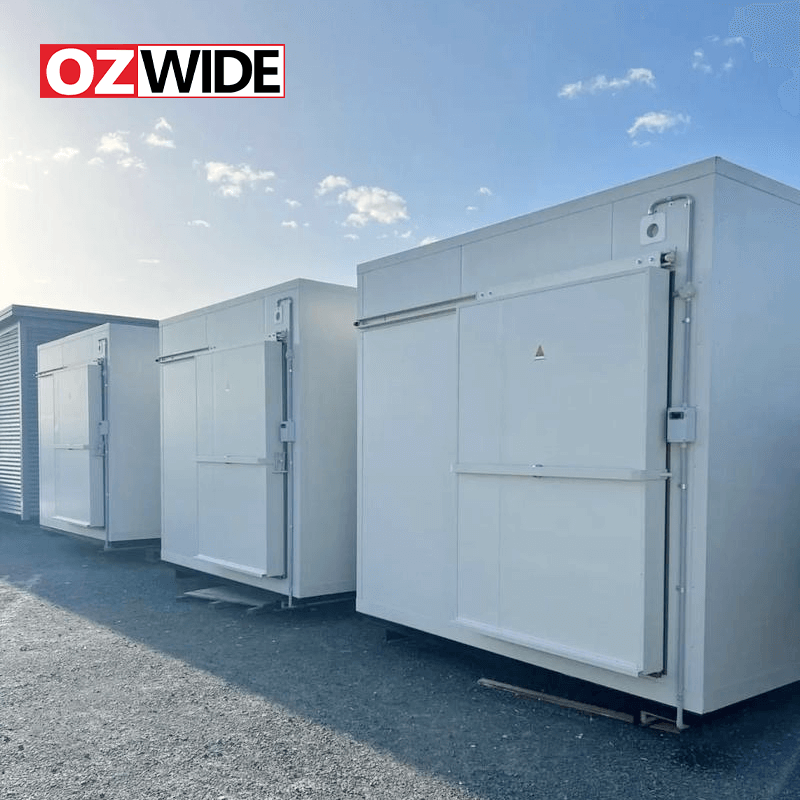
Off-site prefabrication drastically reduces your expansion timeline. Manufacturers build and test the cooling units in a controlled factory environment while you prepare your site concurrently. You completely bypass weather-related construction hold-ups. Site preparation remains incredibly minimal for most modular units. You only need level ground and basic electrical hookups. You avoid pouring specialized insulated concrete foundations entirely. This eliminates weeks of curing time, rebar tying, and heavy machinery rentals.
You can deploy a refrigerated container in a matter of days. This rapid deployment allows you to capture sudden market opportunities. You can accept large, unexpected shipments without turning away business due to space constraints. Flexibility extends to the physical placement of the units. You can position them in parking lots, unused yard space, or adjacent to existing loading docks. If your workflow changes, you can simply hire a crane or heavy forklift to relocate the unit to a more efficient spot on your property.
Commercial-grade seals prevent thermal bridging effectively. Modern cooling units maintain consistent, highly controlled temperatures regardless of outside weather. High-quality Modular Cold Storage units meet strict regulatory standards easily. Advanced microprocessors monitor internal conditions continuously. They adjust cooling cycles, initiate defrost sequences, and modulate fan speeds to compensate for door openings and ambient changes.
Data-logging capabilities provide the audit trails essential for regulatory compliance. You can export temperature history reports for health inspectors instantly via USB or cloud portals. Remote monitoring features send alerts directly to your smartphone or facility management system. You receive immediate notifications if temperatures deviate from the set parameters or if a power loss occurs. This prevents catastrophic inventory loss during off-hours. The insulated panels feature high R-values to resist heat transfer. This ensures your products remain safe even during extreme summer heatwaves.
Install redundant PT100 temperature sensors to verify internal conditions accurately.
Utilize cloud-based data loggers for seamless FDA and USDA compliance reporting.
Configure automated SMS alerts for any temperature excursions, door-open alarms, or power drops.
Perform regular thermal mapping with strategically placed probes to identify and eliminate potential hot spots.
Calibrate all monitoring equipment annually to maintain compliance with health department regulations.
Using combined containers for shipping and storage cuts transportation costs significantly. You minimize product transfers between different cooling environments. This lowers your manual labor costs immediately. It drastically reduces the risk of temperature excursions during loading and unloading. Every time you move temperature-sensitive goods from a truck to a warehouse, you risk a cold chain break. Modular units allow you to keep products in a single, controlled environment from origin to destination.
You can utilize cross-docking strategies more effectively. Load a container at the farm, transport it via flatbed, and plug it in at the distribution center. This seamless transition preserves product quality, reduces spoilage, and extends shelf life. You reduce the need for intermediate staging areas in your warehouse. Fewer forklift touches mean less product damage, fewer dropped pallets, and less packaging wear.
You gain a massive operational advantage by adding or removing units as volume dictates. Respond instantly to seasonal peaks like harvest seasons, holiday rushes, or promotional events. You can lease additional units for three months and return them afterward. This elastic approach prevents you from overbuilding permanent capacity. You never pay to cool empty space during your slow season.
You can physically relocate the storage asset to new distribution nodes. If you open a new branch, you can move the cold storage with you. This preserves your initial investment completely. You can test new markets without committing to a permanent facility lease. If a specific region underperforms, simply transport the unit to a more profitable location. This agility is impossible with traditional brick-and-mortar construction, where your investment is permanently bolted to the ground.
Avoiding new construction reduces concrete and steel usage drastically. Cement production is a major contributor to global carbon emissions. Modular units bypass this heavy environmental toll entirely. Modern units feature high R-value insulation to trap cold air effectively, reducing the workload on the compressor. They utilize variable speed drives that adjust power draw based on real-time demand, rather than running at full capacity constantly.
These components measurably lower your daily electricity consumption levels. Older, traditional facilities often leak cold air through degraded structural joints and failing vapor barriers. Prefabricated panels maintain their airtight integrity for decades. Many modern refrigeration units use eco-friendly refrigerants with low global warming potential. You can also pair outdoor modular units with solar panel arrays and battery banks. This creates an off-grid or hybrid cooling solution for remote locations. You achieve sustainability through measurable efficiency rather than vague greenwashing claims.
Restaurants face constant space constraints in their kitchens. Modular units handle seasonal menu changes and catering overflow easily. You can store bulk holiday ingredients without crowding your daily prep lines. Maintain strict food safety standards without expanding your permanent kitchen footprint. Ghost kitchens utilize these units to manage high-volume delivery ingredients across multiple virtual brands.
You can place a walk-in cooler in an adjacent alley or parking space. This keeps raw meats physically separated from fresh produce, preventing cross-contamination. Event caterers rely on portable units for large outdoor festivals. You can plug them into portable generators to keep ingredients safe on-site for multi-day events. They provide a clean, compliant environment for high-capacity food storage, complete with diamond-tread flooring to prevent slip hazards during busy service hours.
Farmers battle the clock during harvest season. You must deploy portable units directly at the harvest site. Immediately remove field heat from produce to halt the ripening process. This farm-gate cooling extends shelf life significantly. Berries and leafy greens degrade rapidly if left in ambient heat. Pushing pallets directly into a modular cooler preserves their market value and visual appeal.
You can stage these units at the edge of your fields on temporary gravel pads. Once the harvest ends, you can power them down, wash out the interiors, and secure them until next season. You do not need to build a permanent packing house on agricultural land. This preserves your acreage for planting while solving your immediate cooling needs.
Deploy units directly adjacent to harvest fields for immediate rapid cooling.
Utilize forced-air cooling attachments to pull heat out of vented produce boxes quickly.
Store delicate berries at optimal humidity levels to prevent weight loss and shriveling.
Relocate units to different fields as various crop varieties reach maturity throughout the season.
Healthcare logistics demand absolute perfection in temperature control. You must store vaccines, blood plasma, and temperature-sensitive biologics safely. Modular units provide the ultra-low temperatures required for modern mRNA vaccines. You must utilize redundant cooling systems to prevent any single point of failure. If one compressor fails, the secondary unit takes over instantly.
Strict compliance tracking is mandatory to meet rigorous industry standards. Hospitals use modular units to expand their pharmacy storage during health crises or facility renovations. You can deploy them quickly in hospital parking lots during emergencies. They feature backup generators and automatic transfer switches. This ensures uninterrupted power even during severe grid failures. Commercial-grade security locks and biometric access panels prevent unauthorized access to controlled substances.
Portable does not mean exempt from municipal regulations. You must always verify local zoning laws and setback requirements. Some cities classify shipping containers as permanent structures after a certain duration, triggering property tax assessments. You may need to apply for a temporary use permit or a variance. Ensure you have a properly graded, load-bearing surface before delivery.
A fully loaded refrigerated container weighs tens of thousands of pounds. Placing it on soft asphalt or mud will cause it to sink unevenly. This can warp the frame, misalign the doors, and prevent the gaskets from sealing properly. Pour a concrete pad, lay heavy-duty gravel, or use steel road plates for outdoor placements. Consult with your local fire marshal regarding clearance requirements. You must maintain adequate space around the unit for condenser ventilation and emergency access.
Power failures pose a massive risk to your inventory. Evaluate your existing electrical infrastructure thoroughly before ordering a unit. Most industrial cooling units require dedicated 3-phase power. Attempting to run them on standard residential voltage or undersized breakers will destroy the compressor. Hire a licensed electrician to install the correct receptacles, disconnect switches, and breakers.
You must install backup generators to protect temperature-sensitive goods. Configure an automatic transfer switch to activate the generator instantly during an outage. Test your backup power systems monthly under a full load to ensure reliability. Voltage drops during peak summer hours can also damage refrigeration equipment. Install phase monitors and voltage regulators to protect the delicate microprocessors in the cooling unit. Never use extension cords to power a commercial cold storage unit.
Outdoor units require specific, aggressive mitigation tactics. Apply weatherproofing treatments to prevent rust on steel components, especially if located near coastal areas. Ensure commercial-grade seals block pest ingress completely. Rodents will actively seek out warm compressor housings during winter months, chewing through wiring and causing catastrophic failures.
Install heavy-duty mesh screens over all ventilation intakes. Secure the main doors with hardened steel padlocks and tamper-proof lock boxes. This prevents unauthorized access and deters cargo theft. Install motion-sensor lighting and security cameras around the unit's perimeter. Perform routine inspections of the door gaskets. A torn gasket allows warm, moist air to enter the unit. This causes ice buildup on the evaporator coils and forces the compressor to overwork. Regular preventative maintenance extends the lifespan of the asset significantly.
Inspect door gaskets weekly for tears, compression damage, or ice buildup.
Clear debris, snow, and vegetation away from the exterior condenser coils regularly to maintain airflow.
Lubricate door hinges and locking mechanisms with food-grade grease to prevent rust and binding.
Schedule bi-annual inspections by a certified commercial refrigeration technician to check refrigerant levels.
Touch up any exterior paint scratches immediately with rust-inhibiting primer to prevent corrosion.
Modular cold storage represents a viable, long-term strategic asset. It empowers businesses requiring agile, compliant temperature control without the delays of permanent construction. You must choose modular solutions when you need rapid deployment, face uncertain long-term volume, or operate on leased premises. They provide the flexibility to adapt to volatile market conditions instantly. You protect your capital by investing in a relocatable, scalable asset.
Take the following actionable steps to begin your expansion:
Conduct a comprehensive power audit with a licensed electrician to verify your 3-phase capabilities and available amperage.
Measure your available outdoor footprint, accounting for door swings, forklift turning radiuses, and ventilation clearances.
Verify local zoning setback requirements and fire lane clearances with your municipal building department.
Define your exact daily pallet throughput to determine the necessary door configurations and cooling capacity.
A: A well-maintained modular unit typically lasts 10 to 15 years. Lifespan depends heavily on routine maintenance, structural durability, and the operating environment. Regular compressor servicing, coil cleaning, and prompt rust treatment on exterior panels will extend this lifecycle significantly.
A: Requirements vary drastically by municipality and the duration of placement. Some areas allow temporary placement without permits, while others classify them as permanent structures requiring full zoning approval. Always consult your local building department before scheduling delivery to avoid fines.
A: Consumption varies based on unit size, ambient outside temperature, and your target internal temperature. A standard 20-foot reefer maintaining freezing temperatures might draw 15 to 25 amps of 3-phase power continuously. Variable speed compressors help reduce this overall energy draw during off-peak hours.
A: Yes, they are highly capable of maintaining sub-zero environments. Many units can easily hold temperatures at -20°F (-29°C) for deep freezing. Specialized blast freezer units can drop temperatures even faster to preserve product cellular structure and meet strict food safety guidelines.
A: Reefer containers feature rugged steel construction designed for outdoor use and dual-use shipping. Prefabricated cold rooms utilize insulated panels designed primarily for indoor or sheltered use. Cold rooms offer highly customizable footprints, while reefers come in standard ISO dimensions.
A: If the vendor has inventory, a unit can be delivered in a few days. Once placed on a level surface, an electrician can connect the power in hours. The unit can reach its target temperature and be fully operational within 24 hours of connection.
A: Yes, they utilize heavy-duty exteriors and commercial-grade seals designed for harsh marine environments. These tight seals prevent unwelcome critters from entering. The robust construction easily withstands heavy rain, snow, and extreme ambient temperatures without compromising the interior environment.


